Guides
Panel glide blinds are wide, flat panels of fabric that hang from a track and slide across one another, so a big window or sliding door is covered in a few clean sections and cleared by moving them to one side. We measure, advise on and install panel glide blinds across the Central West and Sydney. Most of the choices are easier to make standing at your door than reading about them, so this guide walks through what we look at when we come out.
They come into their own on openings over two metres wide: sliding and stacker doors out to a deck, a wall of glass in an open-plan room, or a soft divider between the lounge and a study nook. On a narrow bedroom window they're more hardware than the job needs, and a roller blind will do it more simply.
Three things decide whether they suit your home.
All three draw sideways, which is why they're the usual answers for a slider. Where they differ is the look and how they handle light.
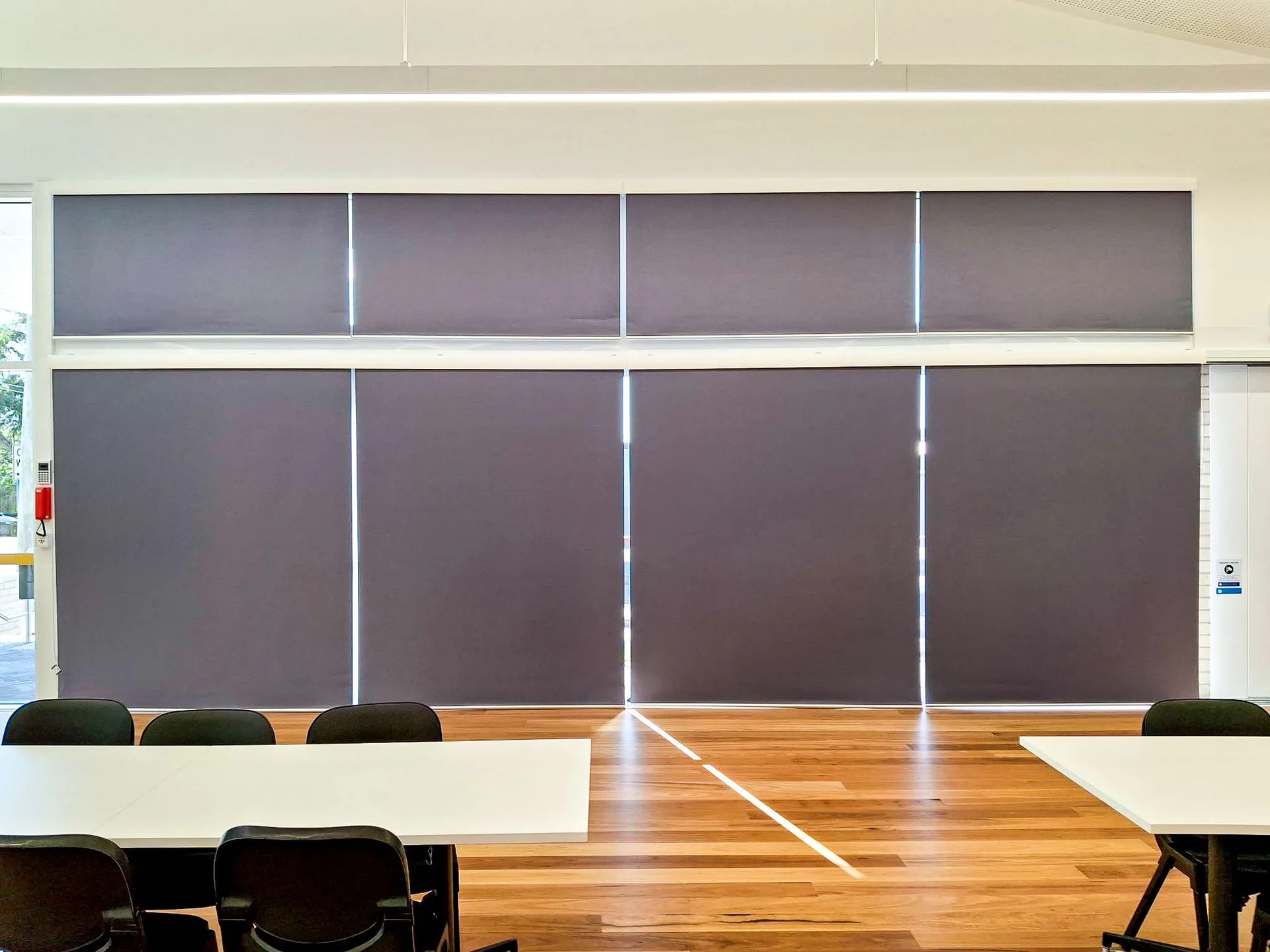
That photo shows why the overlap matters. Roller blinds fitted side by side across wide glass leave a fine line of daylight at every join. Panel glide panels each run in their own channel of the track and cross over one another, so those lines close up.
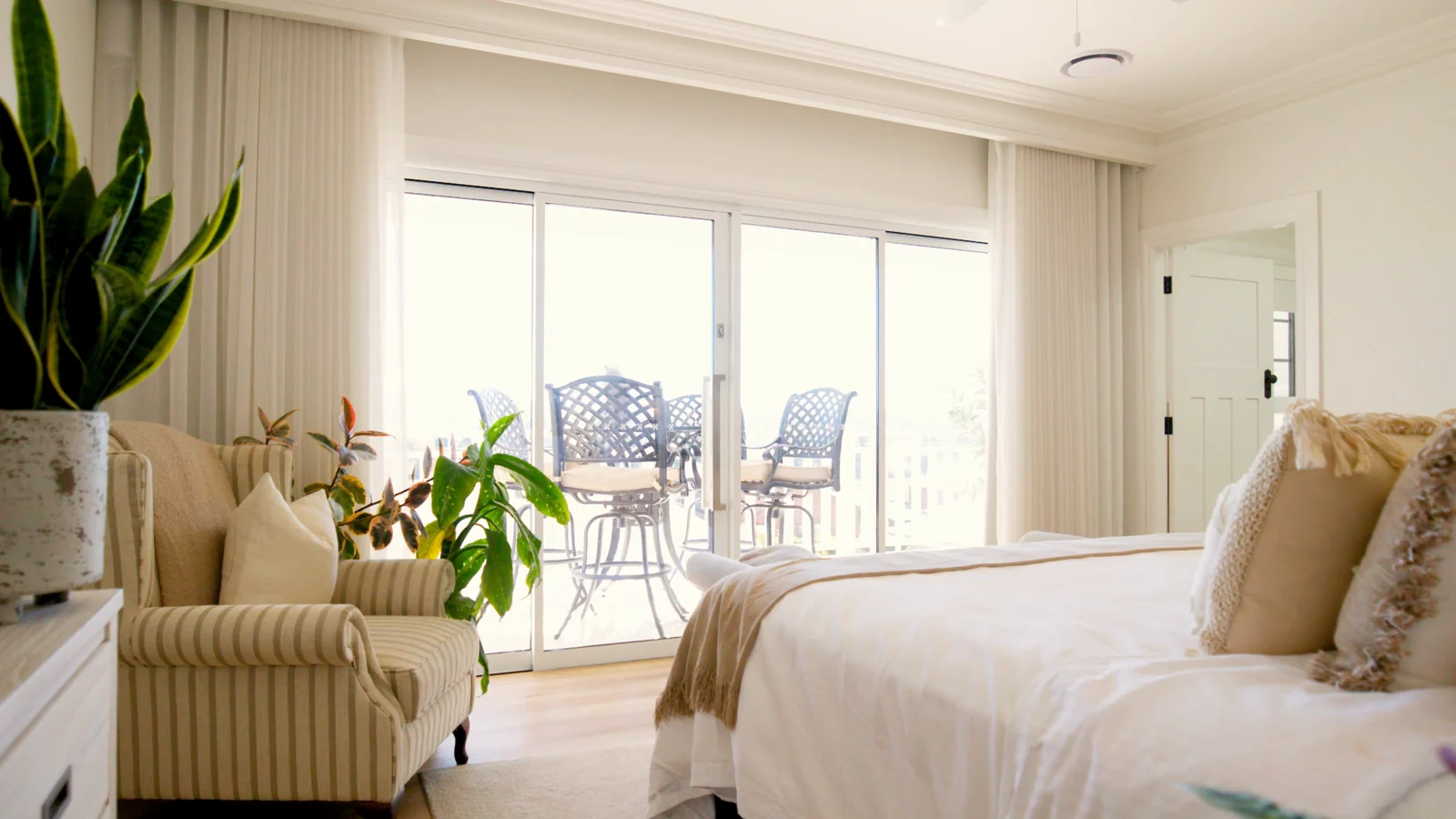
Curtains are often the right call too. In this hillside home in Bathurst, full-height sheers stack back off the glass so the walk out to the pool stays clear, and in this single-storey family home S-fold sheers run across every slider for one soft line through the house.
We work out the panel count from your opening at the measure, but it helps to know the trade-off before we arrive. Fewer, wider panels look calmer when they're closed. More, narrower panels fold away into a smaller bundle when they're open, which matters on a door where every bit of glass you get back is view.
Stacking is one-way, with every panel gathering to the left or the right, or split, with the panels parting in the middle. One-way suits a single sliding door: gather them on the fixed side. Split suits a wide window, or a pair of doors that open from the centre.
Every extra panel needs another channel in the track, and each channel makes the track deeper. That's the first thing we check before suggesting a fit inside the reveal. In an older home with a shallow timber frame there may not be room, so we fix the track to the wall over the architrave, or to the ceiling.
Panel glides hang flat, so the fabric is the whole look. Across the ranges we use there are four kinds:
Screen and light-filtering fabrics keep you private by day, but once the lamps are on inside, people can see in. Our guide to blockout, light-filtering and sunscreen fabrics explains the difference properly, so a bedroom slider usually ends up in blockout.
You can mix colours or fabrics on one track. Some ranges also come in a roman style, with evenly spaced horizontal seams and optional stained timber battens, if flat panels feel too plain for a period home. And because a fabric that looks oatmeal in the showroom can turn grey against a south-facing wall, we bring the samples to your door and hold them up in your own light.
Panel glides run on a wand or a cord. With a wand you take hold of the rod on the leading panel and walk it across, and the panels slide with it. The bottom of each panel carries a base rail or a sewn-in weight, which keeps it hanging flat as it moves.
For a very wide run, or glass that's hard to reach, Silent Gliss make a motorised panel system that works from a switch, a remote or their Move app, and we supply and install it. They also make a Flex system with a bendable carrier, so the panels can follow a corner. It's a tidy fix for a corner window or a room divider that doesn't run in a straight line.
Yes. Fixed to the ceiling, or run on a freestanding track, panel glides slide across to close off a study nook or break up a long open-plan room, then gather away when you want the space back. It's a much lighter job than putting up a wall, and in a sheer or light-filtering fabric the daylight still gets through. On the Silent Gliss systems, the panels also lift off the track for cleaning.
We come to you, evenings and weekends included, with fabric samples. At a sliding door we measure the opening and the wall on either side, check which way you walk out, look at the depth of the reveal and the ceiling above, and note anything the panels have to clear, like a handle or a lock. You get a written quote afterwards, with no obligation.
Your panel glides are then custom-made to order to those measurements, and our own team installs them. We glide every panel through its full travel before we leave, and the packaging goes with us. Everything we install comes with our 2-year warranty against faulty manufacture or installation.
We've been measuring and fitting windows since 1977, from Bathurst, Orange, Mudgee and Dubbo across the Central West, to Sydney's eastern suburbs and lower north shore. If you're weighing up blinds against curtains for the colder months, our piece on curtains for Central West winters is worth a read before we visit.
Book a free measure and quote, or drop into our Bathurst showroom to see the fabrics in person.
Yes, especially openings over two metres. Have the panels gather on the side of the door that doesn't open, and give the bundle some wall to sit on so the doorway clears.
In a blockout fabric, very nearly. No light passes through the cloth itself, and the joins close up where the panels cross. Some still creeps in at the sides, and a track fixed over the architrave and a little past it cuts that down.
Yes, on systems like the Silent Gliss motorised panel track, which runs from a switch, a remote or an app. Otherwise it's a wand, which is simple and leaves no cord hanging down.
Choose panel glides for a flatter, quieter look with fewer joins. Choose verticals if you want to tilt the vanes to let light in while keeping some privacy.
It depends on the width, the drop, the fabric, the number of panels and how you open them. We measure for free and send a written quote, so you know the full cost before you decide.
Custom-made and installed by our own team since 1977. Book a free in-home measure and quote.
Book a Free Measure & Quote