Guides
The right roller blind is the one chosen for the room it's going in: blockout where you sleep, sunscreen where the view matters, and two blinds on one bracket where a room needs both. This roller blinds buying guide covers the questions we work through with you at a free measure and quote.
We're a family business that has been fitting windows since 1977, and we measure and install across the Central West and Sydney. Every roller blind we sell is custom-made to order in Australia to the sizes we take, then installed by our own team. So this guide is less about how to order online and more about what to think through before we arrive, and what we look for once we're standing at your window.
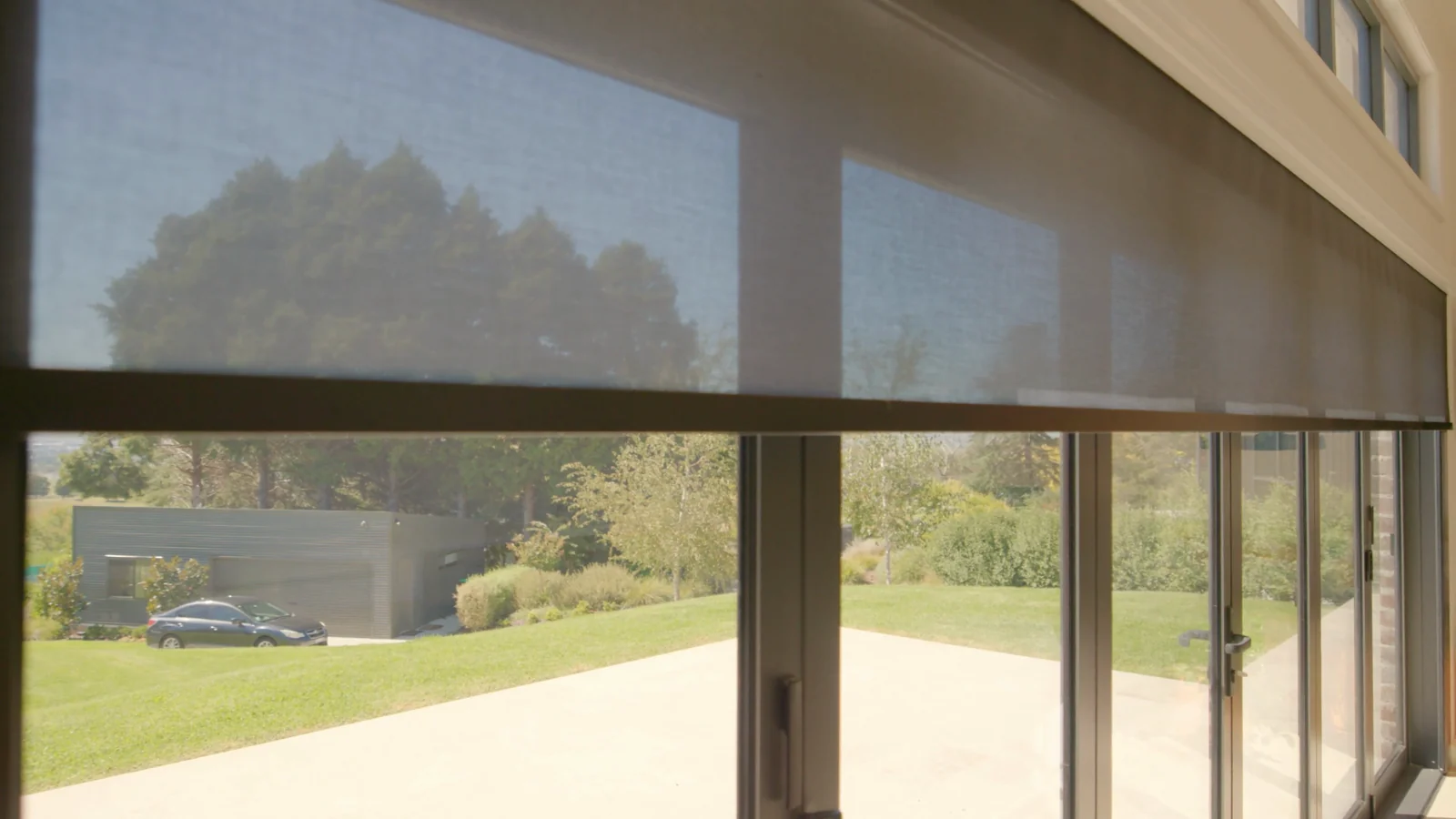
A roller blind is a length of fabric on a tube, raised and lowered by a chain, a spring or a motor. The tube and brackets are much the same from one blind to the next. The fabric is what makes it a bedroom blind or a lounge room blind, so the first question we ask isn't "which colour?" but "what do you need this window to do at 7am, at 3pm and at 9pm?"
Roller fabrics come in three light levels: blockout, light-filtering and sunscreen. We've written a whole piece on blockout vs light-filtering vs sunscreen, so we won't repeat it here. The short version is that blockout is for sleep and screens, light-filtering gives a bright room that's private by day, and sunscreen keeps your outlook while it cuts the glare.
The detail people don't expect is openness. Sunscreen fabrics are woven to a set openness, commonly 3%, 5% or 10%. A lower number means a tighter weave, less glare and less view. For a west-facing lounge that cops the afternoon sun, we usually start the conversation at 3 to 5%. On a south window where glare isn't the problem, a more open weave can keep more of the garden in the room.
If a room only ever needs one thing, one blind does the job. A media room wants dark. A study with a view wants glare control. Done.
Plenty of rooms need two things, though. A bedroom that faces the street wants soft daylight and privacy during the day, then proper dark at night. That's where a dual roller earns its place: two blinds on one set of brackets, usually a translucent fabric for daytime with a blockout behind it for night. As standard, the back blind rolls off the back of its tube and the front blind rolls off the front, so the two fabrics clear each other.
A dual takes more room at the top of the window than a single. If you'd like a pelmet over it to hide the rolls, we allow around 150mm of internal depth for a double, against 85 to 100mm for a single on a face fit. We measure for that at the window, so it isn't something you need to work out yourself.
We can supply roller blinds chain operated, spring operated or motorised. Each suits a different window.
We've covered what motorising really involves, and what drives the cost, in our guide to motorised blinds and curtains.
A reveal fit sits inside the window recess for a tidy, built-in look. A face fit mounts on the wall or architrave and overlaps the opening, which closes down the light around the edges.
Which one works depends on things that are easy to miss with a tape measure in one hand. Is the reveal deep enough for the roll to clear the glass? Is the opening square, or does it lean a few millimetres? Is there a window winder, a lock or a tiled sill in the way? Will a bedroom be dark enough with the slim gap a reveal fit leaves at each side?
Our measurer checks all of that on the day. For a reveal fit, the maker takes a 3mm allowance off the width so the blind runs freely, which is why we always want the true opening rather than a size someone has already trimmed. If you're curious about the process, our how to measure for blinds article walks through it, but you don't need to do it yourself. That's what the free visit is for.
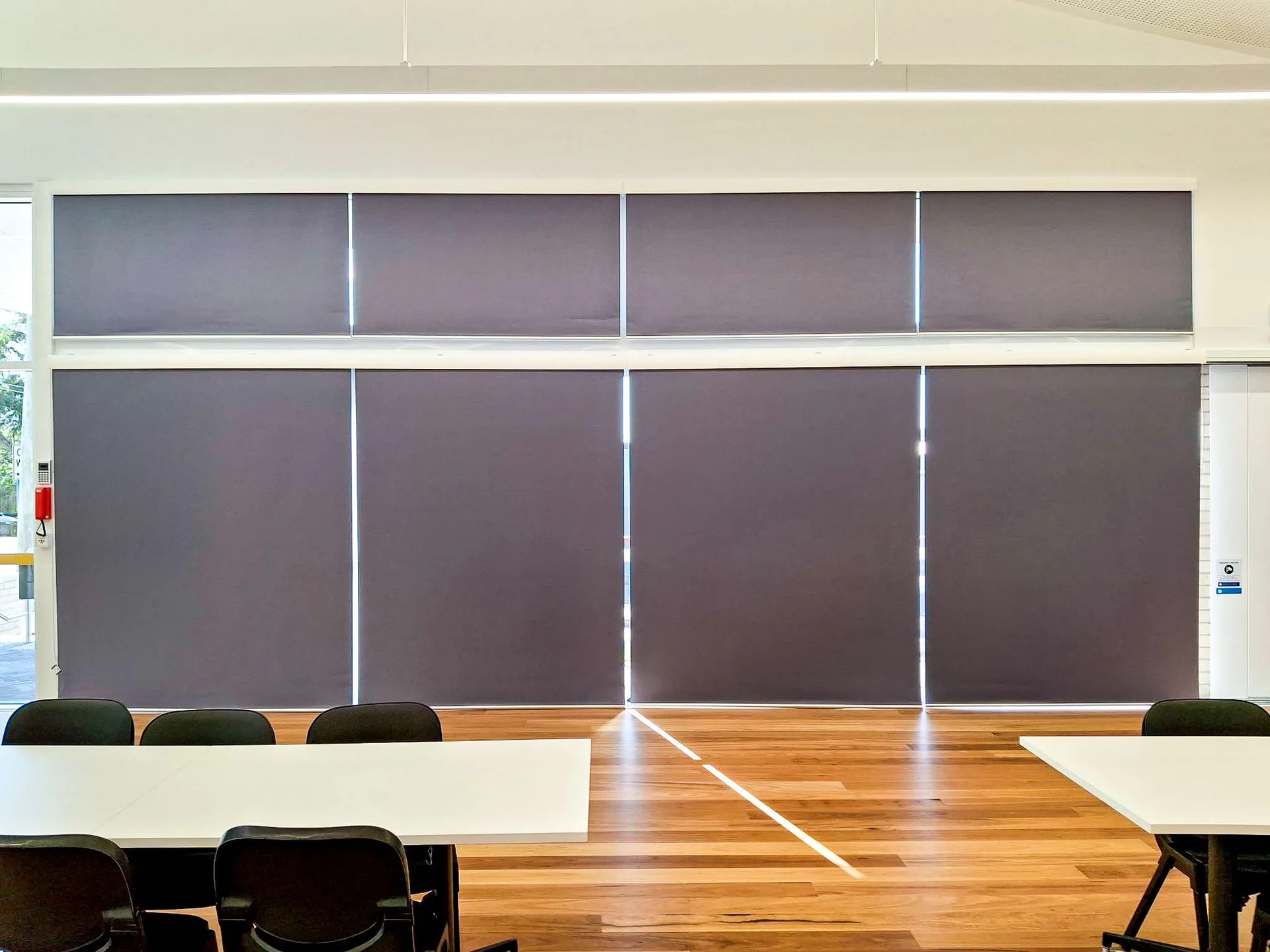
That photo shows the one thing every roller blind does: where two blinds meet, or where a blind sits inside an opening, a thin line of light gets through. On a big commercial job like this one we used metal cassettes at the head and linked the blinds so several run together. At home, a face fit or a pelmet is usually how we deal with it.
The neatest roller blinds we install are the ones nobody can see when they're up. That means planning a pocket in the ceiling or the joinery while the frame is still open.
As a guide, a ceiling recess for a single roller needs about 100mm of internal depth, and a double needs about 150mm. If you want the blinds motorised on mains power, the cabling needs to go in at the same stage. For an off-grid cabin outside Bathurst, we fitted a fully recessed, Somfy-motorised roller blind concealed in the joinery, so it disappears when raised and there's no cord or fixing in sight.
Get us in at framing stage and those details are simple. Leave it until handover and the options narrow to what fits on the face of the wall.
On a rural property at Mount Panorama, the brief was to take the heat and glare off a long run of living-room glass without losing the view to the ranges. We went with sunscreen roller blinds in an openness that holds the outlook, and softer curtains in the bedrooms where privacy mattered more. That's the photo at the top of this page. The view is still the first thing you see.
Most homes end up with a mix like that. Sunscreen in the living areas, blockout in the bedrooms, and sometimes a dual roller where one room has to do both. Have a look at our roller blinds page for the full range.
Every installation is covered by our 2-year warranty against faulty manufacture or installation. Prefer to see fabrics first? Drop into our Bathurst showroom.
Blockout, nearly always. For a street-side bedroom where you'd also like daylight, we pair the blockout with a translucent fabric on a dual bracket: private by day, dark at night.
Common openness factors are 3%, 5% and 10%. A tighter 3 to 5% suits west windows with strong afternoon glare; a more open weave keeps more view where glare is less of a problem.
Yes, if the recess is planned before the plaster goes on. Allow about 100mm of internal depth for a single roller and 150mm for a double.
Not with a battery motor such as Somfy WireFree, which recharges and runs without a power point. A mains motor needs power run to the window by an electrician.
Yes. Our team measures every window at your free measure and quote, your blinds are custom-made to order, and we install them.
Book a free measure and quote and we'll bring the samples to you.
Custom-made and installed by our own team since 1977. Book a free in-home measure and quote.
Book a Free Measure & Quote