Guides
A roman blind is one panel of fabric that lifts into horizontal folds and lies flat when lowered. Choose one where you want fabric at the window without full curtains: bedrooms, studies, dining rooms and character homes. We measure, help you choose and install it.
We've measured and fitted window furnishings from our Bathurst showroom since 1977, for homes across the Central West and in Sydney's Eastern Suburbs and Lower North Shore. Our roman blinds are custom-made to order for each window and installed by our own team. This guide covers the decisions we talk through with you at the free measure, so you can walk in knowing what you like.
The fold style sets the whole character of the blind, so we start here.
The fabric changes the fold as much as the style does. Unlined blinds and natural fibres like linen drape softly. Lined blinds and synthetic fabrics sit firmer, with straighter folds. If you're after the relaxed look, we'll usually steer you to a natural fibre.
For a heritage home with leadlight, deep reveals or period joinery, a flat or relaxed roman in a neutral linen tends to sit quietly with the architecture instead of fighting it. We fit them in character homes around the Central West regularly.
Lining is where a roman blind earns its keep, and it's the question we get asked most on site.
One thing to know if you want a properly dark bedroom: stitching through a blockout lining can leave pinpricks of light along each fold line. Lining strips sewn over those lines stop it. Full darkness also depends on the fit, which we'll look at when we measure. Our post on blockout vs light-filtering vs sunscreen fabrics goes deeper on light levels.

There are three ways to lift a roman, and the right one depends on the size of the blind and who's using it.
You might also see a cord lock offered. We're wary of them in recesses, in corners, under pelmets, across bay windows and on large blinds, roughly over 2.4 metres wide or 2.1 metres drop, because they're not recommended there. On those windows we'll talk you into a chain or a motor instead.
When a roman is raised, its folds gather at the top and stay there. That's the part people don't expect. Fitted inside the recess, the folds hang over the top of the pane. Fixed to the wall above the architrave, they rest against the wall and you get the whole window back.
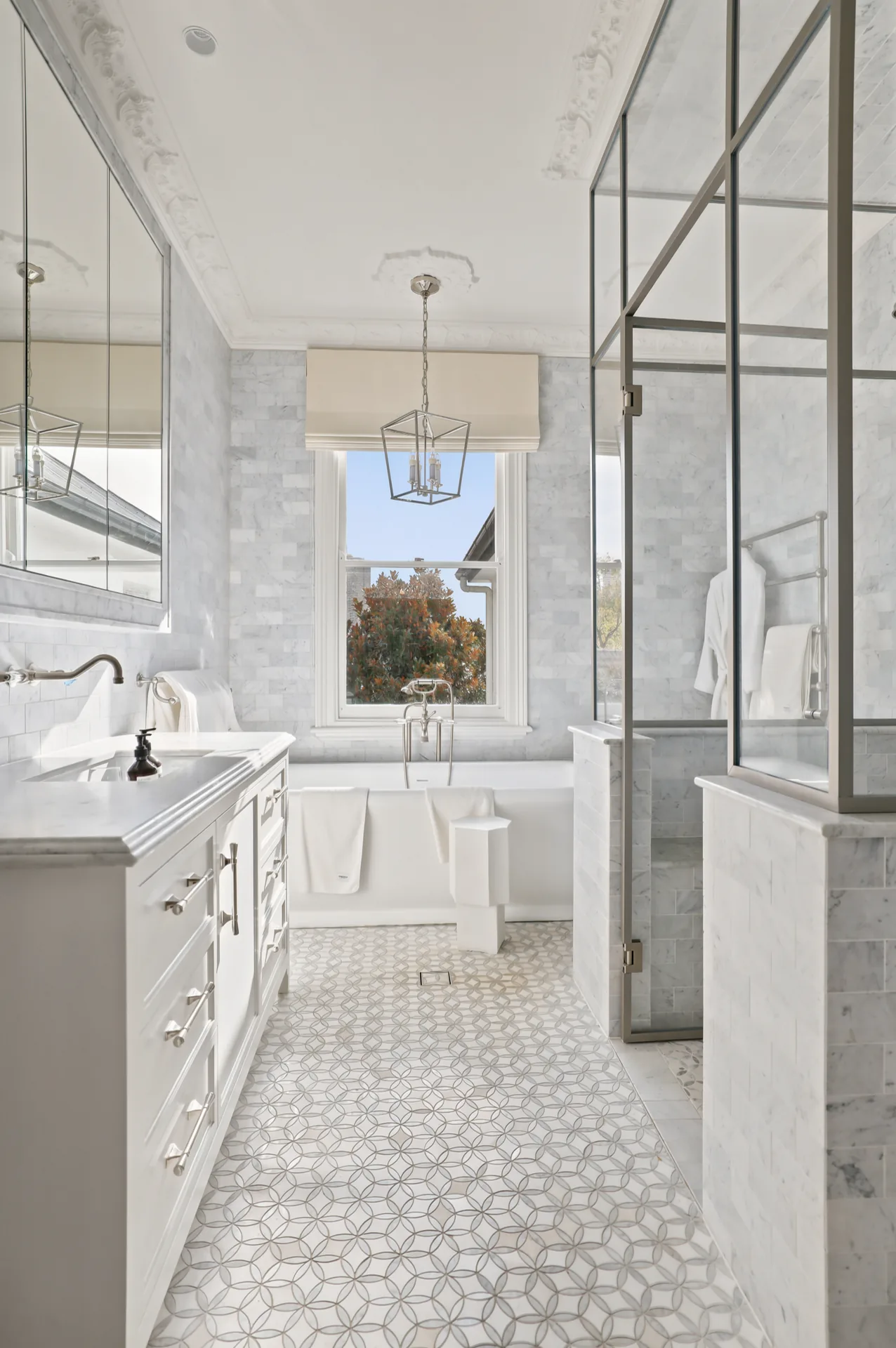
On a lot of jobs we fix the headrail above the frame for exactly that reason. In a joined pair of terraces we fitted out in Paddington, the guest bedroom and ensuite romans both sit above their windows, so when they're up the view is clear.
A recess fit still looks beautiful where the reveal is deep and square, and in an older home it shows off the timber. On a tall drop, over about 2 metres, fixed inside a recess or onto plaster above the architrave, we use a deeper headboard so the blind hangs true. These are the calls we make standing at your window with a tape, which is why we'd rather measure it ourselves.
Size matters too. Some of the roman systems we use go up to 3 metres wide and 3 metres drop, with a limit of 6 square metres in area. On a bigger window we'll usually split it into two or three blinds that line up.
Romans are at home in bedrooms, living and dining rooms, studies, bay windows and French doors. They're also the obvious partner for curtains: a roman does the everyday light control and the curtains frame the window. Our guide to choosing curtains or blinds room by room covers that pairing.
Where we'd think twice: hard up against a shower, or right behind a sink where water hits the fabric. Folds trap moisture and grime more than a flat blind does. A large, airy ensuite with the window away from the shower, like the Paddington one above, is a different story. If you need every bit of the view with the blind raised and can't fix above the frame, a roller blind rolls away into a much smaller space.
If you love a pattern, it's matched across any vertical joins in the blind. Styles with seams across the face suit plain fabrics or vertical stripes better, so the seams don't cut through the design. Where a room has several windows in a row, we have the battens and pattern lined up from blind to blind so the room reads as one.
Already found a fabric you love? We can have a roman made up in your own fabric, and we'll cover that in its own post.
Keep it simple. Vacuum it now and then with the soft brush attachment, with the blind lowered so the folds open out. For anything more than dust, call a professional curtain and blind cleaner. On some fabrics we can have a protector like Scotchgard applied when the blind is made; just ask.
We come to you, evenings and weekends included, bring fabric samples and measure every window. You see the fabrics in your own light, beside your walls and floors, which is the only way to judge a colour. The person who measures your windows is the person who installs the blinds, so nothing gets lost in a handover.
On install day we fit everything in one visit, test every blind before we leave and take the packaging with us. Your blinds are covered by our 2-year warranty against faulty manufacture or installation. If you're curious about what we look for with the tape, our post on how we measure for blinds explains it.
Ready to see fabrics against your windows? Book a free measure and quote, or drop into our showroom at 16 Bradwardine Road, Bathurst.
Yes. With a blockout lining, and lining strips over the stitch lines, a roman will darken a bedroom while still looking like a soft furnishing rather than a utility blind.
The folds gather at the top when it's raised, so fitted inside the recess they cover the top of the glass. Fix it above the frame and the folds sit on the wall instead.
Yes. A small motor sits in the headrail and lifts the blind with no cord or chain, run by a remote or a home system.
Neither is better; they suit different rooms. A flat fold looks crisp and works with patterns, while a soft or casual fold gives a relaxed drape and looks its part in linen.
Yes. We measure and install across the Central West, including Orange, Dubbo, Mudgee and Lithgow, and in Sydney's Eastern Suburbs and Lower North Shore.
Custom-made and installed by our own team since 1977. Book a free in-home measure and quote.
Book a Free Measure & Quote